
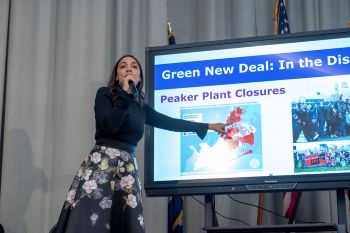
Rep. Alexandria Ocasio-Cortez took the stage at Al Sharpton's March on Washington "Defend the Vote" rally at the Lincoln Memorial on August 28th and told a predominantly black crowd that "sixty-three years ago, hundreds of thousands gathered right here and changed the course of our nation's history." She delivered it in a drawling cadence that would've had most people checking whether she'd recently relocated from the Bronx to Birmingham.
Then the accent started slipping. Mid-sentence, AOC appeared to lose track of which voice she was doing and began stuttering through the transition. The clip went viral almost immediately.
This isn't new territory for the congresswoman from New York's 14th District. Just six weeks earlier, on July 17th, she was in Memphis campaigning for progressive state representative Justin Pearson's House bid in Tennessee's 9th District, where she rolled out another version. "We cannot afford to leave Tennessee behind. We cannot afford to leave Kentucky behind, Alabama behind, Mississippi behind, Georgia behind, South Carolina behind," she told the crowd, sounding like a tent revival preacher who'd wandered off the circuit.
That same Memphis appearance produced another gem. "Sister Pressley and I were in Montgomery, Alabama," AOC said, referencing Rep. Ayanna Pressley, "and one of the things that we said was that it is time for the North to roll up to the South." She called the crowd "brothas and sistahs." She's from Westchester County.
Actor Michael Rapaport noted AOC was "from the 'Bronx' sounding like a southern Baptist preacher while in Memphis." Conservative strategist Steve Guest put it more directly: "Hillary Clinton developed an accent. Kamala Harris developed an accent. AOC is developing an accent. It's all patronizing."
Ben Domenech, who's actually from Mississippi and South Carolina, had the sharpest take: "That does not work. That does not work. We catch that immediately. You cannot code-switch like that!"
AOC has defended the shifting voices before. After a 2019 appearance at Sharpton's National Action Network convention — where she told the crowd "I'm proud to be a bartender, ain't nothing wrong with that" in yet another accent — she tweeted that she's "from the Bronx" and acts and talks "like it, especially when I'm fired up and especially when I'm home." The problem with that defense is that the Bronx doesn't sound like Memphis, which doesn't sound like Montgomery, which doesn't sound like the Lincoln Memorial version, which doesn't sound like the committee-hearing version.
The real issue isn't that politicians adjust their tone for different audiences. Everybody does that to some degree. The issue is that the adjustments are so theatrical and so transparently calculated that they reveal exactly how these audiences are viewed — not as communities to represent, but as demographics to perform for. You don't adopt somebody's dialect unless you think the dialect is what connects with them, not the substance.
She's got the New York committee-hearing voice. The Memphis tent-revival voice. The Montgomery sisterhood voice. The D.C. rally voice. Somewhere in there is the one she actually uses at home, but at this point, she may have forgotten which one that is too.