
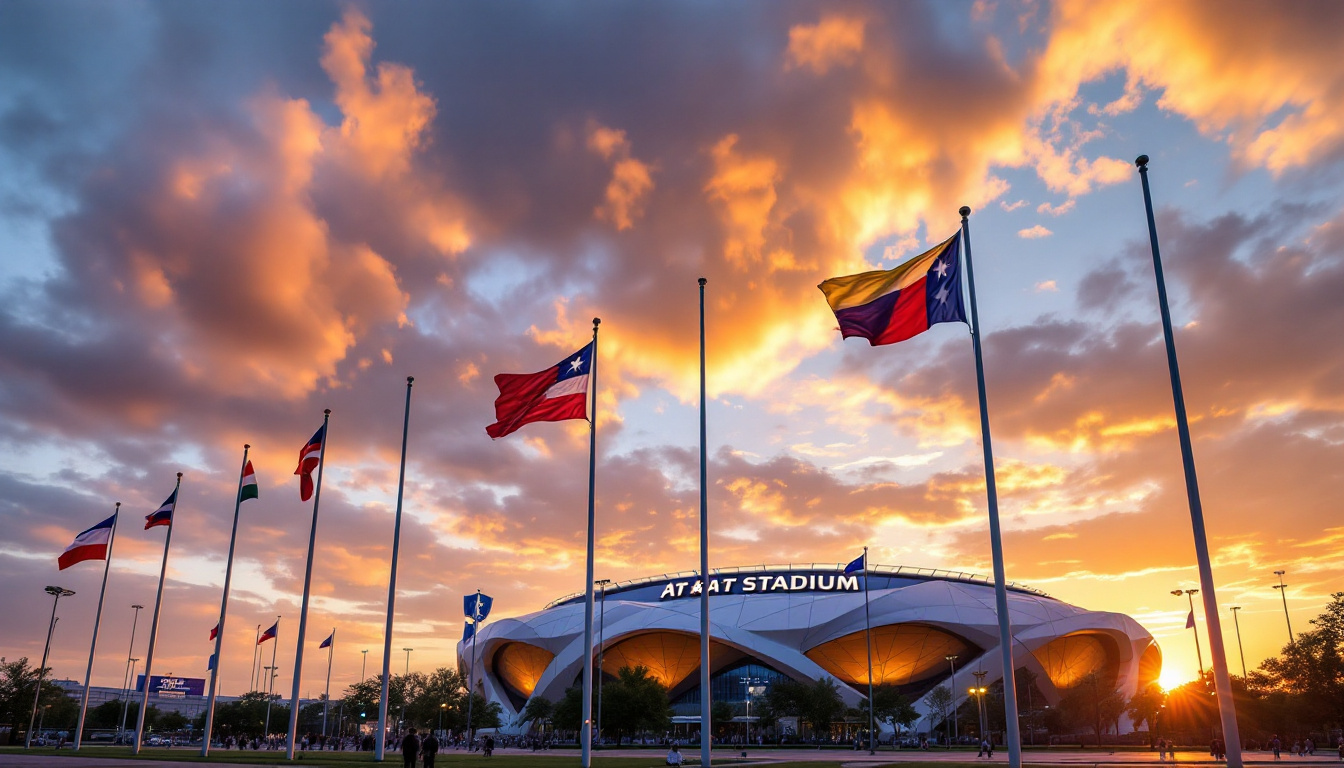
Oliver Henry, an English football fan, stood inside AT&T Stadium in Arlington, Texas last Friday, watched England beat Croatia 4-2, and then did something almost unheard of for a Brit abroad. He apologized.
"We owe America a huge apology about their stadiums," Henry posted online. "They are simply better than ours."
The 2026 FIFA World Cup is barely two weeks old, and something remarkable is happening that has nothing to do with the scores. Tens of thousands of European fans — British, Scottish, German, Italian, Japanese — flew into American cities expecting whatever their media had told them to expect. What they found instead was free refills, strangers who make eye contact, gas stations the size of theme parks, and a country that apparently does everything bigger, friendlier, and cheaper than advertised.
Henry's video from the 80,000-seat AT&T Stadium — home of the Dallas Cowboys, retractable roof, the whole production — went viral almost immediately. But it was his follow-up that landed harder. "The people of Texas have been the friendliest and most accommodating people I have ever met," he wrote. "Part of my heart will forever stay in Texas." He's already looking ahead to England's next match against Ghana at the Boston stadium on Tuesday, and by all accounts, he's not the only European whose travel diary has turned into an unsolicited Yelp review of the entire country.
The phenomenon has a pattern. Visitors arrive, film themselves discovering something ordinary — a Target run, a restaurant portion that could feed a family of four back in London, a cup of coffee with ice and free refills — and post it with genuine astonishment. Scottish fans descended on Boston in such numbers that locals started calling the city "New Scotland." One group rented a house for the tournament and played bagpipes at 6 AM, which is either cultural exchange or an act of war depending on how much sleep the neighbors got.
A Scottish fan walked into a Buc-ee's for the first time and described it as "a gas station mixed with Disney World wrapped in a gift shop." That's not a review. That's a religious experience.
Marina De Buchi, a British entrepreneur and content creator who moved to California last year, told ABC News she's been watching the wave of reaction videos with a knowing smile. "A lot of people say Americans are fake and I just don't think that's true," De Buchi said. "I think Americans are just really nice and friendly." Her advice to visiting Europeans was simple: "Just indulge in it. Because there's just so much here."
The moments generating millions of views aren't the stadiums or the skylines. They're the mundane things. Free ice. Drink refills that keep coming without a surcharge. Pickup trucks that Europeans photograph like wildlife. Supermarkets with aisles wider than some London flats. One Italian tourist posted a video marveling at complimentary ice-cold beverages — a concept so foreign to European dining that it registered as a luxury.
Shawn Moran, a Boston content creator documenting the city's World Cup atmosphere, summed up what he's been witnessing on the ground. "People are simply having fun and enjoying each other's company, learning about other cultures and embracing them wholeheartedly," Moran said.
Jim Rooney, President and CEO of the Boston Chamber of Commerce, has been tracking the economic and cultural impact. The city prepared for an international influx and got one — but the story that's traveling isn't about logistics or infrastructure spending. It's about visitors discovering that the country they'd been told was divided, rude, and in decline is actually the place where strangers hold doors, cashiers ask how your day is going, and a gas station sells fresh brisket at 2 AM.
None of this is news to anyone who actually lives here. We know the refills are free. We know Buc-ee's is a national treasure. We know Texans will invite you to dinner after a five-minute conversation at a tailgate. The part worth noting is where these visitors got the impression that America was something else entirely — and what changed their minds.
It wasn't a PR campaign. It wasn't a tourism board video. It was contact. They showed up, walked around, talked to people, and the story they'd been sold fell apart in about forty-eight hours.
As the New York Post reported, the running theme across dozens of these viral posts is the same three words: "We were wrong."
Turns out the best argument for America is America. You just have to actually visit.