
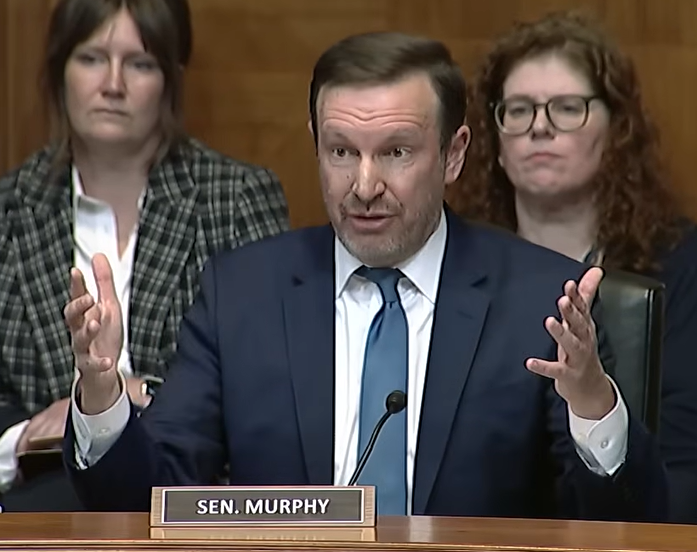
Sen. Chris Murphy of Connecticut sat down on Jennifer Welch's podcast last week and made a case for government regulation of social media. Not to protect children from predators. Not to stop foreign interference. To make people less likely to vote for Donald Trump.
"Regulating the internet so that you're spending less time alone on Instagram should be an" — and the rest of the sentence doesn't even matter, because the quiet part was already out.
Murphy's argument, stripped of its public-health packaging, is straightforward: Americans who spend time on unregulated social media platforms are more likely to support candidates like Trump. Therefore, the government should step in and reduce the time citizens spend on those platforms. The connection between regulation and electoral outcome wasn't implied. It wasn't subtext a hostile journalist had to dig for. Murphy drew the line himself, on a podcast, on camera, with his name attached.
The clip went viral within hours of posting, and the reactions were immediate. One commenter called it "fascism" — which, to be fair to the word, is closer to the dictionary definition than most of its modern applications. Another compared Murphy to "a CCP party member," which sounds like hyperbole until you remember that the Chinese Communist Party's actual position on internet regulation is that uncontrolled information flow threatens the stability of one-party rule. Murphy just said the same thing with an American accent.
What makes this different from the usual "we need to regulate Big Tech" noise is the specificity of the ask. Murphy didn't call for antitrust reform. He didn't propose data-privacy legislation. He proposed reducing how much time Americans spend online — and connected that reduction directly to weakening Trump's voter base. The mechanism isn't complicated: platforms like X, under Elon Musk's ownership, stopped filtering conservative content. Traffic to independent media went up. Democratic messaging advantages eroded. Murphy's solution isn't to win the argument. It's to shut down the forum where he's losing it.
We've seen earlier versions of this playbook. In 2022, the Biden administration launched the Disinformation Governance Board under Nina Jankowicz — a short-lived experiment in government-supervised speech that collapsed under public ridicule within weeks. Before that, there was the coordinated pressure campaign on social media companies to suppress stories like the Hunter Biden laptop coverage ahead of the 2020 election. Murphy's contribution to the genre is simply the most honest one. He skipped the euphemisms.
The standard Democratic rebuttal on tech regulation is that it's about mental health, teen safety, algorithmic manipulation — anything but political advantage. That framing depends on nobody actually listening to what the regulators say when they think their audience already agrees. Murphy was on a friendly podcast. He wasn't being cross-examined. He was explaining, to people he assumed were sympathetic, why the government needed to intervene in how Americans consume information. And the reason he gave was Trump.
Notice what Murphy didn't say. He didn't say social media is making people believe things that aren't true. He didn't say platforms are spreading Russian propaganda. He said people are spending too much time on Instagram and it's making them vote wrong. The problem isn't misinformation. The problem is information — the unfiltered kind, arriving without a network anchor to explain what it means.
Every few months, a Democratic official gets caught articulating the actual theory behind the rhetoric. It happened with Jankowicz. It happened when former CNN host Jim Acosta spent years treating press access as a constitutional entitlement. It happened when Tim Walz, during his vice-presidential campaign, struggled to explain why "hate speech" exceptions to the First Amendment were a good idea. Murphy just added his name to the list.
He proposed regulating how much time Americans spend reading things the government can't control, and he told you why: the wrong people keep winning elections.