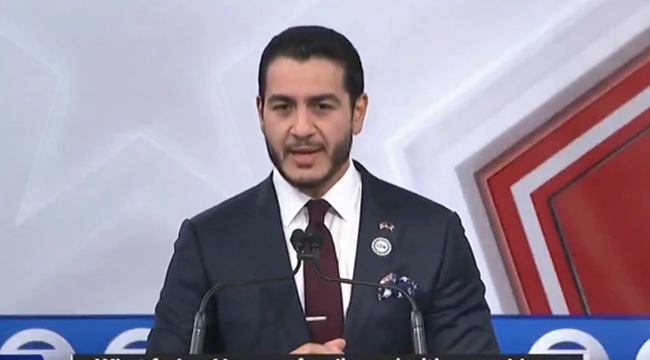
Abdul El-Sayed, the Democratic Senate candidate in Michigan, has a problem. A political ad supporting his campaign told voters that U.S. support for Israel is the reason their grocery bills are too high. El-Sayed himself has echoed the message, suggesting Americans have to set grocery money "aside for killing Palestinians" because of aid to Israel.
Then Van Jones watched it.
"This is an example of anti-Jewish hate, and it should be taken down immediately," Jones said on CNN NewsNight on October 27. "And denounce, and by the way, Abdul should denounce this ad immediately."
That's Van Jones. Not Ben Shapiro. Not a Republican strategist. Van Jones — the man CNN keeps on payroll specifically to defend Democrats through their worst news cycles. When he's calling your ad antisemitic on live television and demanding you denounce it by name, you've crossed a line that even the most reliable party loyalists won't cover for.
Scott Jennings, CNN's conservative commentator, didn't disagree. He just added the economic absurdity on top. "It's economic incoherence wrapped up in anti-Semitism," Jennings said. "El-Sayed himself in this campaign has argued we can't have good education in this country because we fund the Iron Dome, which is completely wrong, nuts, economic incoherence. By the way, eggs, like $2.70 a carton, bananas, 40 or 50 cents a pound."
The ad featured Michigan residents blaming U.S. support for Israel for high grocery prices — a claim that falls apart with roughly four seconds of arithmetic. American aid to Israel is a rounding error on the federal budget compared to the domestic spending programs El-Sayed's party has championed for years. But the ad wasn't designed to make economic sense. It was designed to channel frustration at the checkout line toward a very specific foreign target.
Watch the ad for yourself
El-Sayed's campaign responded by claiming the ad wasn't affiliated with the campaign. That's the standard distance play — we didn't make it, we can't control outside groups, nothing to do with us. But El-Sayed himself had already made the same argument the ad makes, tying Iron Dome funding to education shortfalls and grocery costs to Palestinian aid. The ad didn't invent the message. It amplified the candidate's own words.
And when Jones demanded El-Sayed denounce the ad immediately, the candidate didn't.
Michigan's Senate race is one of the most closely watched midterm battlegrounds in the country, and El-Sayed has been courting a coalition that includes a significant Arab American voter base in Dearborn and surrounding communities. The ad reads like a calculated appeal — wrap a foreign policy grievance in kitchen-table economics and hope nobody notices the scapegoating underneath. Jones noticed. Jennings noticed. The question is whether Michigan voters are paying the same kind of attention, or whether the ad runs long enough to do its work before the denunciations catch up.
El-Sayed's campaign says the ad isn't theirs. El-Sayed's own rhetoric says otherwise. Eggs are $2.70 a carton. That has nothing to do with the Iron Dome.