
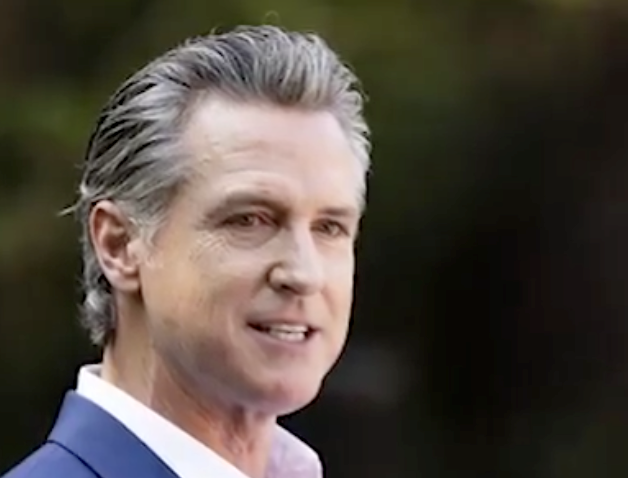
Five hundred and forty-eight people sat on California's death row — the largest death row in the Western Hemisphere. Serial killers. Child murderers. Cop killers. As of today, every single one of them has been resentenced to life in prison without parole, courtesy of Governor Gavin Newsom.
Not one victim's family got a vote.
Newsom announced the mass commutation on Tuesday, converting all 548 death sentences to life imprisonment without the possibility of parole. He called it "among the most difficult" decisions of his career, then spent the rest of the statement explaining why it wasn't difficult at all. "State-sanctioned killing is incompatible with California's values, undermines the foundations of our legal system and diminishes each of us," Newsom said.
Diminishes each of us. That's the framing. Not the 548 separate acts of violence that put these people on death row — the punishment diminishes us. The murders, apparently, do not.
This wasn't a surprise. Newsom imposed a moratorium on executions in 2019, at the start of his first term. California hasn't actually executed anyone since 2006 — two full decades. The death row inmates were already living on borrowed time. But a moratorium is temporary. A future governor could reverse it. Commutation is permanent. Newsom made sure no one after him could finish what the juries started.
And that's the part that deserves attention. These weren't sentences handed down by Gavin Newsom. They were handed down by juries — real people, from real communities, who sat through weeks of testimony about what these 548 individuals did to other human beings and concluded that the maximum penalty was the only appropriate response. Newsom overrode all of them in a single afternoon.
"I know we cannot execute people in our imperfect legal system and remain true to our core values, first among them justice and human decency," he added. Justice. He used the word justice while nullifying 548 jury verdicts. The system he's calling imperfect is the same system that convicted these people — the trials, the appeals, the decades of legal review. The convictions are fine. The sentences are the problem. Convenient.
He did acknowledge, briefly, that this might be painful for victims' families. "I know its announcement may surface excruciating memories for victims' families," he said. Then he followed it with: "I hold this painful truth along with the belief that this is a righteous action." He holds it. He holds their pain right alongside his belief that he's doing the right thing. And then he does what he was going to do anyway.
The "imperfect legal system" argument sounds principled until you notice who benefits from the principle. Not the wrongly convicted — those cases can be addressed individually, and routinely are. This was a blanket commutation. Every sentence. Every case. The guy who murdered a family of four and the guy whose case had a procedural question mark — same outcome. Newsom didn't review 548 cases and determine justice required mercy in each one. He made a policy decision and applied it to all of them, because sorting through the details would have been inconvenient and the headline wouldn't have been as clean.
California voters, it's worth remembering, have rejected efforts to abolish the death penalty. They voted to keep it in 2012. They voted to keep it again in 2016 — and that time they also voted to speed up the appeals process. The electorate looked at this question twice in four years and said: keep it, and make it work faster. Newsom looked at that and said no.
Thirty years in public service, and this is the legacy project. Not fixing the housing crisis. Not the homelessness that turned San Francisco into a cautionary tale. Not the businesses that fled to Texas and Florida. The thing Gavin Newsom needed to get done before leaving office was making sure 548 convicted killers would never face the sentence that juries gave them.
California hasn't executed anyone in twenty years. It just made that permanent.