
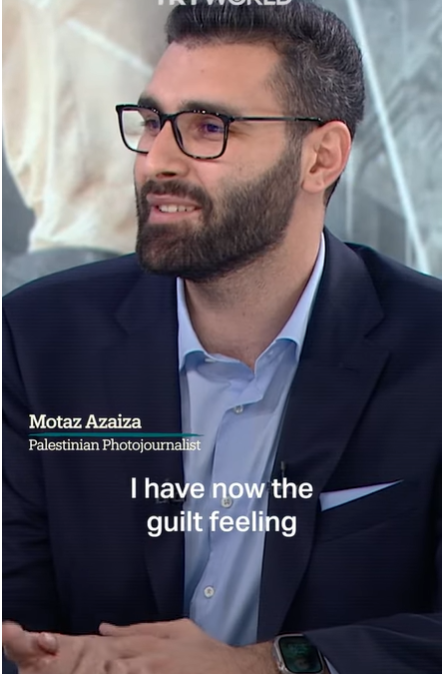
"People got out, watched, beat them, hit them, and I followed them and filmed. But I did not publish those videos."
That's Motaz Azaiza, the 25-year-old Palestinian photojournalist who became a global celebrity for his Gaza coverage, explaining in his own words what he did on October 7, 2023. He watched Israeli hostages get beaten. He filmed it. And then he buried the footage to help Hamas cover up their crimes.
Azaiza's reasoning is worth reading in full because it tells you everything about how Palestinian "journalism" works. "I chose not to publish it because I feared that revealing the location could put Palestinian civilians in the area at risk," he said. Then the quieter admission: "I did not want to ruin the lives of the people who were filmed. I understood that Israel would use those videos to identify every person who was there and eliminate them."
So a journalist watched civilians assault kidnapped hostages, recorded the evidence, and then suppressed it specifically to protect the perpetrators from being identified. He wasn't worried about context. He wasn't worried about editorial standards. He was worried the people beating hostages might face consequences.
That's not journalism. That's obstruction.
Azaiza went further, admitting that Gaza's media environment operates under direct Hamas control. "Photographers in Gaza have become accustomed to lowering their cameras the moment someone says something bad about Hamas because anyone who dares to show reality is persecuted relentlessly," he said. Hamas runs a group chat that includes all journalists operating in the territory — a coordination channel for what gets filmed and what doesn't.
Every Western outlet that cited "journalists on the ground in Gaza" as independent sources just got a problem. The guy telling you this isn't a disgruntled whistleblower from the outside. This is the single most decorated Gaza journalist of the entire war — the one Time Magazine named to its 100 Most Influential People list, the one nominated for the Nobel Prize, the one who spent 108 days documenting Gaza under bombardment and became an international icon for it.
Azaiza met with Hamas chief Ismail Haniyeh in Doha. He participated in pro-Hamas protests at Columbia University. None of that stopped Western newsrooms from treating his footage as gospel, building segments around his reporting, amplifying his social media posts as frontline truth.
The defense from press freedom advocates will be that Azaiza operated in an impossible environment where defying Hamas meant death. That's probably true. It's also the entire point. If every journalist in Gaza self-censors under Hamas threat — and Azaiza just confirmed they do — then every piece of footage, every casualty number, every narrative that emerged from Gaza's media apparatus during this war carries the same asterisk. The information didn't pass through a free press. It passed through Hamas.
And Western media didn't caveat it. Didn't flag the sourcing limitations. Didn't tell audiences that the journalists they were citing operated inside a system where filming the wrong thing got you "persecuted relentlessly." They ran the footage clean, with network logos in the corner, as if it had the same editorial independence as a reporter filing from London.
Azaiza had video of hostages being beaten by a mob. Time Magazine gave him a profile. Columbia gave him a platform. The Nobel committee put his name on a list.
He filmed it all. He just chose which parts you got to see.