
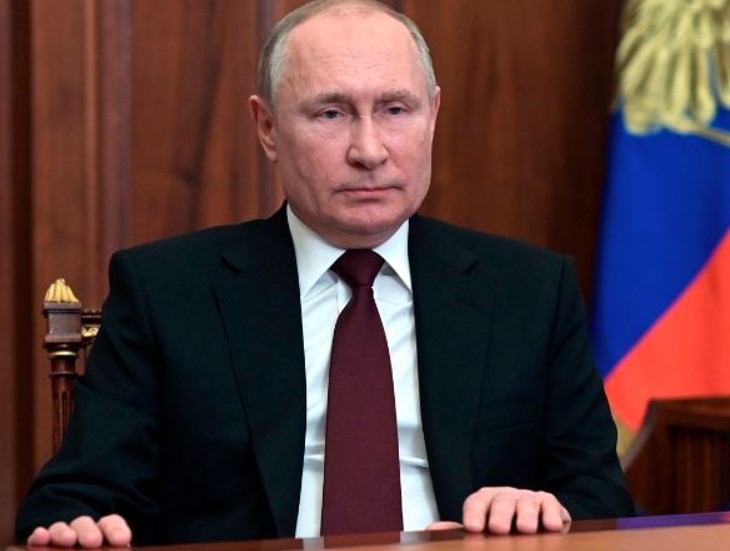
Vladimir Putin has reportedly told Kremlin insiders three words that explain everything about the last five years: "They will hang me."
The Russian president isn't talking about NATO. He's not talking about sanctions. He's talking about what his own people will do to him if he comes home without a win in his war with Ukraine.
Putin privately fears that losing the war in Ukraine — or even ending it without capturing all of Donbas — could mean a Gaddafi-style ending for himself.
Which reframes everything we've watched for nearly five years. The escalation. The mobilization decree from September 2022 that's still in effect. The 400,000 additional soldiers reportedly being prepared. The nearly 1,500 drones launched over a single four-day stretch, more than half of them jet-powered. None of it is strategy. It's survival.
Publicly, Putin is still playing the strongman. On August 22, he addressed the nation with the kind of line you'd expect from a guy who definitely isn't panicking: "The special military operation continues. We will move only forward."
Only forward. Because backward means a noose.
Meanwhile, the destruction is accelerating. Russia has reportedly wiped out roughly 90% of Ukraine's food logistics infrastructure. Commercial targets. Oil. Energy. The campaign isn't aimed at Ukrainian soldiers — it's aimed at Ukrainian civilization. Kyiv's ability to function as a country is the target.
Ukraine hasn't exactly been sitting still. Ukrainian drones have been hammering Russian oil, energy, and logistics infrastructure in return. President Volodymyr Zelensky has used every Western weapon system available to make Russia's war as expensive as possible. But the asymmetry is obvious. Russia can absorb hits to its oil infrastructure. Ukraine can't absorb losing 90% of its food supply chain.
Some will argue this makes Putin more dangerous — a cornered animal with nuclear weapons. That framing gives him too much credit. A leader who's scared of his own inner circle isn't a cornered predator. He's a guy who knows the people closest to him are already doing the math on what comes next.
Reportedly, the war is becoming increasingly unpopular among Russia's elite, even as Putin's grip on power remains technically secure. That's a familiar pattern. The grip is always secure — right up until it isn't. Every authoritarian who fell in the last century looked stable six months before the end.
Here's what matters for us. We spent four years watching an administration that couldn't define what victory in Ukraine even looked like. Now we have a president who's made clear that the goal is ending the war, not managing it. The difference matters, because Putin's private terror tells us something useful: he knows he can't sustain this forever. He's not fighting to win. He's fighting to not lose.
A man preparing 400,000 more soldiers while privately whispering about gallows isn't projecting strength. He's buying time and hoping nobody on his side figures out there's no plan behind the curtain.