
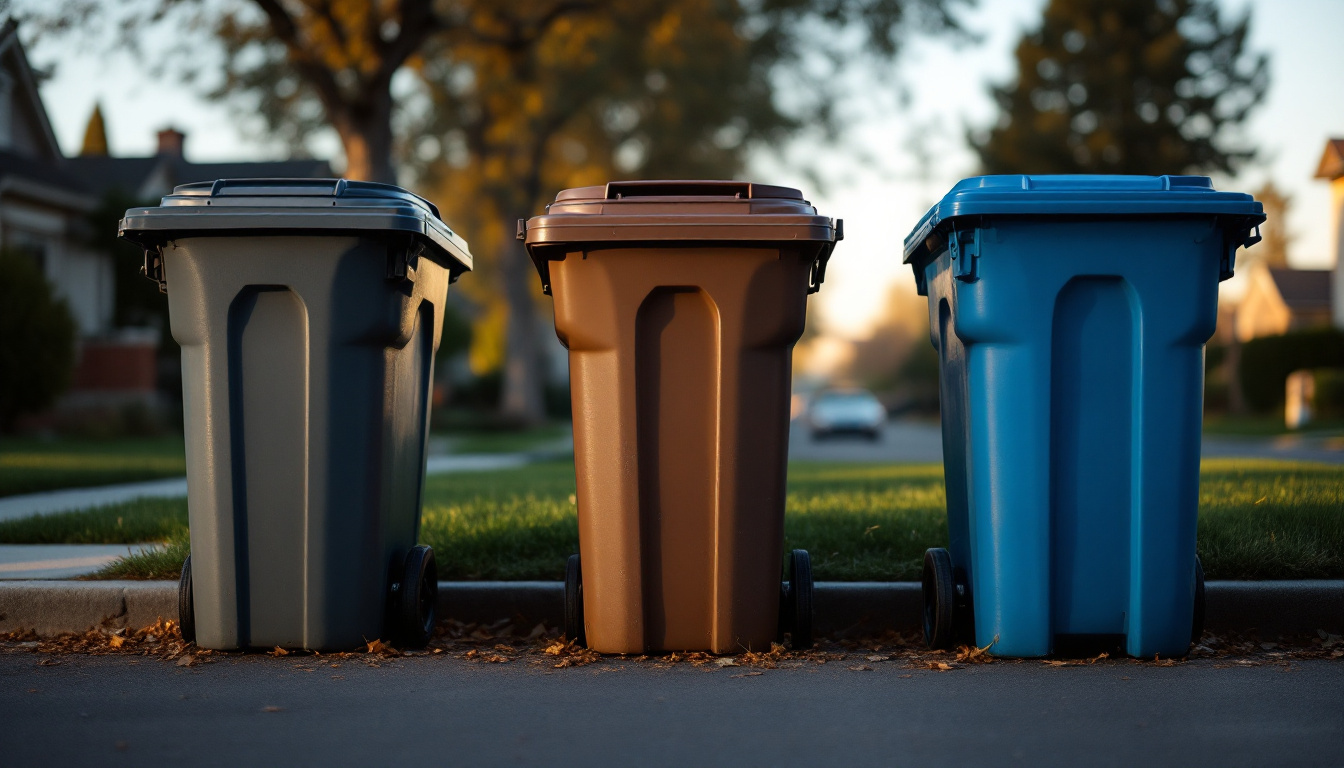
Starting this summer, city employees in Sacramento, California, will fan out across neighborhoods between 6 a.m. and 8 a.m. on trash collection days, lift the lids off 4,800 randomly selected household bins, photograph the contents, and leave a tag on the handle grading your garbage sorting performance.
You get either a "Great job!" sticker or a "Let's sort this out" tag. Like a kindergarten teacher reviewing your homework, except the homework is your trash and the teacher works for the government.
The program is mandated by Senate Bill 1383, California's climate law requiring cities and counties to reduce methane emissions by ensuring residents properly separate their waste into three bins: grey for trash, brown for organic waste, and blue for recycling. Sacramento ran the same program last June, and city spokesperson Jesa David said the results weren't encouraging.
"We conducted the same reviews last June, and we found high contamination levels of, you know, issues like plastic bags in recycling, garbage in the organics," David told CapRadio. The horror. Plastic bags in the recycling bin. Clearly this is the crisis Sacramento needs to pour resources into.
David assured residents that the inspections are purely educational. "There are no penalties of any kind as a result of this. It's simply providing information," she said. The city also insists crews won't physically touch the waste — just peer inside, snap photos, and document what they see. "We just reassure people that we're not keeping any records tied to that home," David added.
No penalties. No records. Just government workers opening your trash cans at dawn to photograph your banana peels. For now.
Sacramento resident J.D. Fontaine wasn't buying the reassurance. "I think it could be invasive. It could lead to other things," Fontaine said, calling it a "Big Brother" situation. The concern isn't crazy. California has a habit of introducing programs as "educational" before bolting on fines and enforcement mechanisms once everyone's acclimated. SB 1383 already authorizes penalties for noncompliance — the city just hasn't pulled that trigger yet.
David made the financial case too. "When you sort your waste incorrectly, it does cost us more to dispose of it," she said. Fair enough. But Sacramento's annual budget runs north of $1 billion, and the city has been battling rising homelessness, property crime, and a housing crisis that makes national headlines. The decision to deploy code enforcement officers to inspect garbage cans rather than, say, address any of those problems tells you everything about where California's priorities sit in 2026.
The state even rolled out cartoon mascots — "Big Blue" and "Binnie" — from CalRecycle to teach residents proper sorting techniques. Because what adults really need when the government is rifling through their trash at 6 a.m. is a cartoon character explaining that coffee grounds go in the brown bin.
Louder With Crowder reported on the program this week, and the reaction was about what you'd expect. A state that can't keep needles off its sidewalks now has the bandwidth to audit whether you put your eggshells in the correct container.
The inspections run through September. Four thousand eight hundred homes. Photographed garbage. Passive-aggressive stickers.
California can't build housing, can't keep the power on during heat waves, and can't figure out why people keep leaving. But your organics bin is sorted wrong, and that they can fix.