
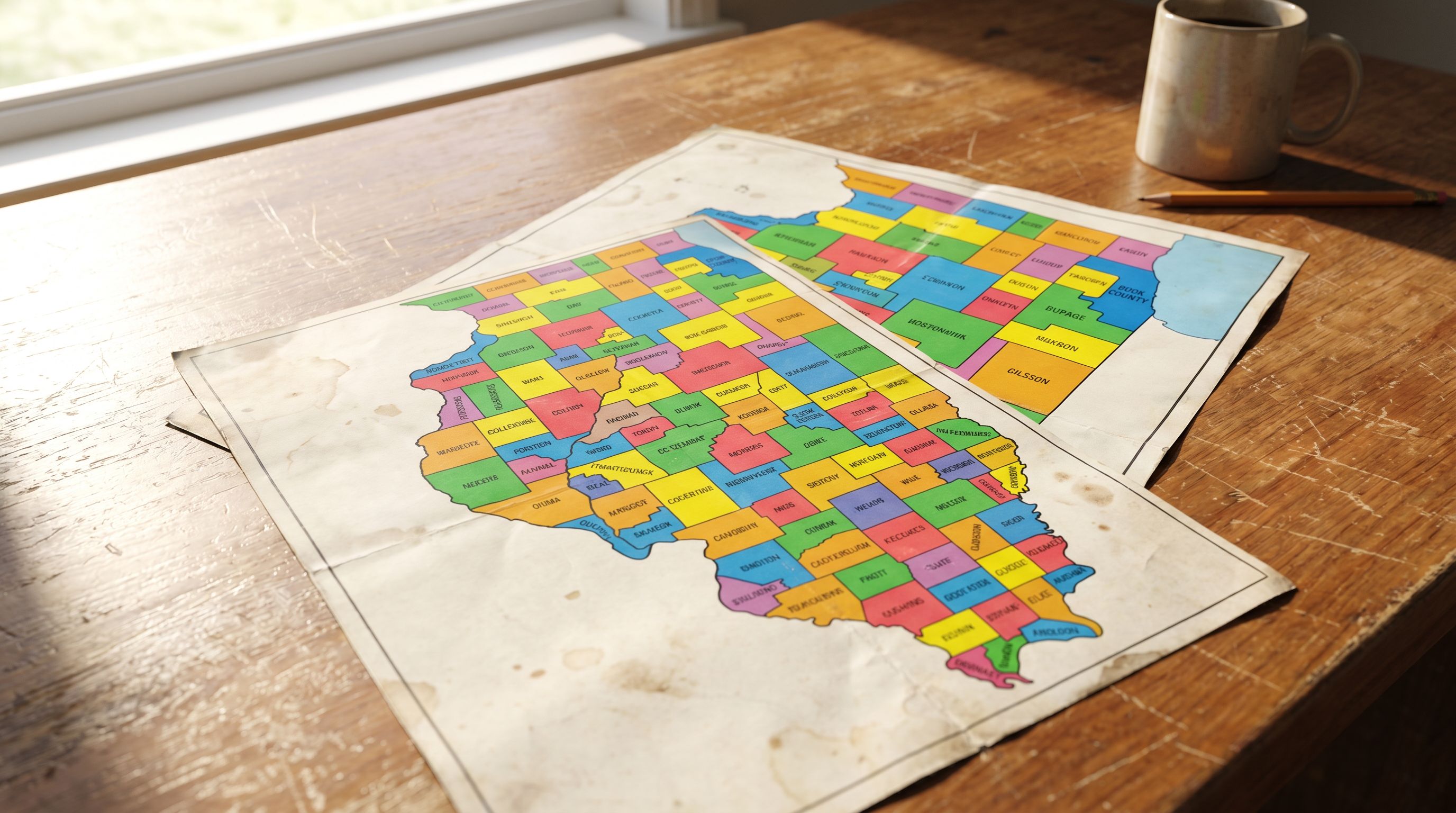
Seven Illinois counties just put separation referendums on the November ballot, asking voters one very simple question: Do you want to form a new state without Cook County? The counties — Coles, Gallatin, Hamilton, Henderson, Macoupin, Monroe, and Saline — would join 33 others that have already approved the same measure.
That's 40 out of 102 counties having the same conversation. At some point, it stops being a protest vote and starts being a consensus.
The movement is built around a resolution introduced by State Rep. Brad Halbrook, a Republican from Shelbyville. HJR 16 urges Congress to designate 101 of Illinois' 102 counties — every county except Cook — as the 51st state in the union. The math isn't subtle. One county dominates the legislature. The other 101 foot the bill.
Halbrook put it plainly to The Center Square: "They don't see that anything's going to change for the positive, and when I speak about that, you know, it's the SAFE-T Act, it's the Protect Illinois Communities Act, the other social issues." He's describing a constituency that has watched Springfield pass law after law that makes their communities less safe and more expensive, and they're done waiting for someone in Chicago to notice.
"Billions of dollars have been transferred from citizens, from businesses into state budgets or into the state treasury," Halbrook said. That's not hyperbole dressed up in a quote. Under Gov. J.B. Pritzker, Illinois has added more than 60 new taxes over eight years. Sixty. That's not a policy disagreement. That's a raid.
The referendums are advisory. They don't redraw any lines. For an actual split to happen, both the Illinois state legislature and the U.S. Congress would have to approve it. The legislature that benefits from the current arrangement would have to vote to end the current arrangement. The legal path is, to put it generously, narrow.
But dismissing the movement because it faces long odds misses what's actually happening on the ground. These aren't fringe counties passing symbolic gestures. Thirty-three have already voted yes. Seven more are queuing up. Indiana's legislature has advanced bills to annex willing Illinois counties. An Iowa lawmaker floated a similar proposal last year. The neighboring states aren't laughing at this. They're opening doors.
The counterargument from Springfield is predictable: the state works better together, downstate benefits from Chicago's economic engine, separation is constitutionally impossible without extraordinary cooperation. All of which may be technically accurate. None of which explains why 60-plus new taxes were necessary, or why the SAFE-T Act made it harder to keep repeat offenders in jail, or why rural school districts keep losing funding while Chicago's pension hole gets another emergency infusion.
What Halbrook and the county boards behind these referendums have figured out is that you don't need to win the legal argument to win the political one. Every county that votes yes is another data point that says the same thing: the people who grow the food, run the small businesses, and pay the property taxes in downstate Illinois do not believe their state government represents them.
Forty counties saying it out loud is a petition. Fifty would be a mandate. Springfield might want to start counting.