
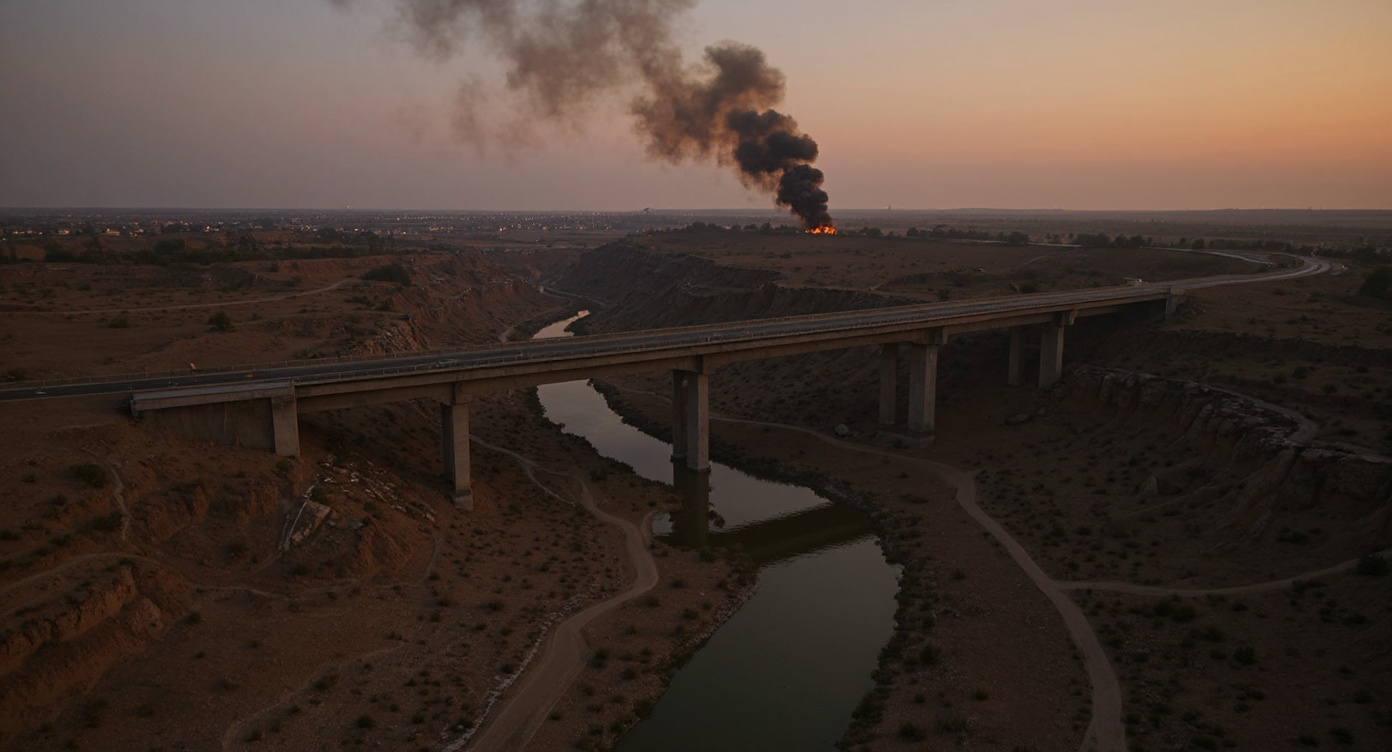
At 9:40 p.m. ET on Wednesday night, U.S. fighter aircraft, drones, and naval assets hit bridges and railway junctions connecting Tehran to Bandar Abbas — a port city of more than 500,000 people that sits on the Strait of Hormuz and serves as the headquarters of the Iranian Navy. It was the sixth consecutive night of American strikes on Iranian military infrastructure.
Six nights. Not a one-off. Not a "proportional response." A systematic dismantling.
U.S. Central Command confirmed the destruction of a surveillance tower at the Chah Bahar Shahid Kalantari Port, stating that "the destruction of the tower directly degrades IRGC's ability to coordinate attacks on innocent civilian crew members." Highway bridges were collapsed. A railway junction was destroyed. Coastal military positions, air defense systems, and maritime capabilities all took hits across what CENTCOM described as a continued effort to degrade Iranian military logistics. Highways connecting Bandar Abbas to surrounding provinces are now closed.
"At the commander in chief's direction, CENTCOM is further degrading Iranian military capabilities," the command said. The targets weren't random. Every bridge, every rail line, every logistics node feeds into the Islamic Revolutionary Guard Corps' ability to project force through the Strait of Hormuz and the Gulf of Oman — the narrow waterways through which a massive share of global energy shipments pass. That's why the navy headquarters sitting on that strait has been the focal point of six straight nights of American firepower.
Secretary of War Pete Hegseth put it in five words: "Iran does not control the SoH."
That's not bravado. That's a statement of operational fact backed up by more than 50,000 U.S. service members currently deployed across the Middle East and six nights of precision strikes that have turned Iran's road-and-rail network south of Tehran into rubble.
The IRGC has been retaliating — or trying to. Strikes have hit targets in Kuwait, Qatar, and Bahrain in recent days. A power generation facility and a water desalination facility were damaged in Kuwait. One child was injured by shrapnel in Qatar. Iran's strategy is the same one it has used for decades: hit soft targets in neighboring countries and hope the international community pressures Washington into stopping.
President Trump was characteristically understated about the timeline: "We are likewise winning big in Iran, and you will see the fruits of that labor very, very shortly."
What makes this campaign different from previous Middle Eastern engagements isn't the firepower — it's the targeting philosophy. The U.S. isn't chasing individual IRGC commanders through Damascus or lobbing cruise missiles at empty airfields for the cameras. It's destroying the physical infrastructure that connects Iran's military apparatus to its most strategically important coastline. Bridges. Roads. Railways. Surveillance towers. The connective tissue between Tehran's orders and the IRGC's ability to execute them at the strait.
Iranian journalist Vahid Online has been documenting the strikes from inside Iran, posting footage of collapsed highway overpasses and severed rail lines that, just a week ago, carried military equipment south toward Bandar Abbas. The images tell a story that Iran's state media would prefer to keep quiet: the road to the Strait of Hormuz is, in a very literal sense, disappearing.
Iran's Energy Ministry has now urged residents to reduce electricity consumption following disruptions to power facilities across the country. That's not collateral damage — that's the point. An IRGC that can't keep the lights on at home has a harder time coordinating naval operations in one of the world's most critical shipping lanes.
Six consecutive nights of strikes against bridges, railways, surveillance towers, air defense systems, coastal positions, and maritime capabilities across Iran's southern corridor. More than 50,000 American service members positioned across the theater. The navy headquarters of a nation that has threatened to close the world's most important oil chokepoint watching its supply lines go dark one by one.
The Strait of Hormuz is still open. Iran's road to it is not.