
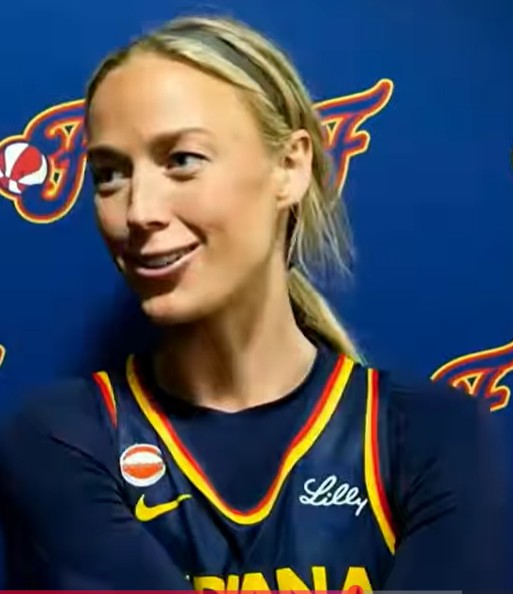
Sophie Cunningham is shooting 43.7% from three-point range this season, good enough for the top five in the entire WNBA. She was mysteriously left out of the league's three-point shooting contest.
Her response: "sooo what else is new with everyone?"
Cunningham, who plays for the Indiana Fever alongside Caitlin Clark, sat down for an ESPN profile that aired this week and said what virtually every female athlete in the country already knows but won't say out loud. "I think that I am here to extend love," she said. "But I also think with that love is truth, being honest. And I want to protect young girls in a locker room, or young girls in sport who shouldn't have to go against biological men."
That's the controversial statement that prompted the WNBA to cut Cunningham from the contest. Protect girls from having to compete against men. In a sane world this wouldn't require an ESPN sit-down or a carefully worded declaration of principles. It would be obvious.
But this isn't the first time Cunningham has been through the machine. Back in March 2022, she re-shared a tweet from CBS Sports host Josh Pate that read, "Female collegiate athletes deserve so much better than this" — a reference to the Lia Thomas situation at the NCAA women's swimming championships, where swimmer Riley Gaines tied with Thomas, who is transgender, but was denied the titled in favor of Thomas. The backlash was immediate. Cunningham was branded transphobic. So was Gaines for saying this is unfair. Both women were accused of hate.
"I got a lot of negative feedback about me hating trans," Cunningham told ESPN. "And I'm like, 'I never once said that.'"
She didn't. She shared someone else's tweet defending female athletes, and the WNBA ecosystem treated her like she'd committed a felony. Four years later, she's still explaining herself — still having to issue the same clarification that any reasonable person would find unnecessary.
Cunningham also made it clear she's not carrying water for any political party. "I'm very much in the middle," she said. "I agree with things on both sides, disagree with things on both sides. And that's all I've ever said about my political beliefs. But people love to assume."
The assumptions came anyway. Online critics labeled her "MAGA Barbie." One wrote, "Sophie Cunningham is unafraid. Unafraid to be blatantly transphobic." Cunningham called the label "projection" — which, for a professional athlete doing a media interview, is about as pointed as it gets.
The WNBA's handling of this tells you everything. You've got a player putting up elite numbers, one of the most recognizable faces in the league thanks to a viral meme from last season, with one of the best selling jersey's in the league — and the league can't even put her in a three-point contest. The snub wasn't subtle. It was a message.
Riley Gaines, who's become the most prominent voice in the fight to keep men out of women's sports since tying with Lia Thomas at the 2022 NCAA championships, used the moment to call on other elite female athletes to speak up. "Let this be a clarion call, not just to Simone, but to every, I think especially elite female athlete, professional female athlete, the likes of Caitlin Clark and Sophie Cunningham, Serena Williams, to link arms," Gaines said.
That's the real story here. The Supreme Court has already upheld state laws keeping biological males out of women's sports. The legal battle is largely settled. Public opinion is settled. The only place where this is still considered a "controversial" position is inside the professional sports-media complex that would rather punish a 43.7% three-point shooter than admit she has a point.
Cunningham put out a statement back in 2022 that read, in part, "You know that I stand with all people, especially my fellow athletes. I do not judge, but support all races, religions, sexual preferences and gender equity. We all have a place in this world to compete and I hope we are able to grant everyone that opportunity fairly."
Four years and one ESPN interview later, she's still saying the same thing. The only difference is she's done apologizing for it.
When "I want to protect young girls" is a fireable offense in a women's sports league, the problem isn't the player.